

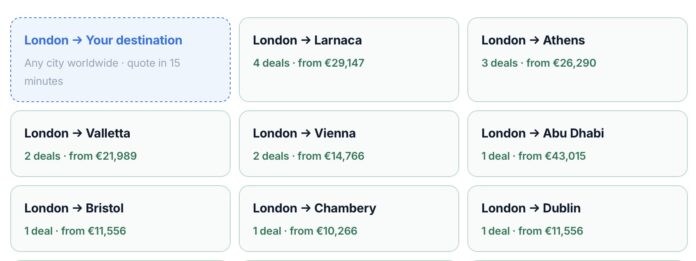
Hiring a private jet from London gives passengers greater control over their departure time, choice of airport and travel arrangements. Unlike scheduled flights, which operate according to fixed timetables, private charters are organised around an individual journey. This flexibility can be particularly valuable for business travellers managing several appointments, families travelling together and passengers visiting destinations with limited commercial connections.
Arranging private jet hire London departures involves several decisions beyond selecting a destination. The choice of airport affects ground travel, while aircraft size, flight distance and availability determine the overall cost. Understanding these factors before requesting a quotation makes it easier to compare offers and avoid paying for capacity or services that are unnecessary.
Private aviation also has practical limitations. Airport operating hours, weather conditions, aircraft positioning and international flight requirements can influence departure arrangements. A well-planned charter takes these restrictions into account rather than assuming that every airport and aircraft will be available at any time.
Choosing the Right London Airport
London has several airports capable of handling private aircraft, but they serve different parts of the capital and offer varying facilities. For many passengers, the time required to reach the departure terminal matters more than the airport’s reputation. A flight from an airport closer to home or the office may save considerably more time than choosing a facility on the opposite side of London.
Farnborough is a dedicated business aviation airport southwest of the capital, particularly convenient for passengers travelling from Surrey, Hampshire and parts of west London. Its facilities are designed around private aircraft operations, although opening hours and flight restrictions must be considered when arranging a departure.
London Biggin Hill, situated southeast of central London, provides another dedicated business aviation option. Its location can suit travellers coming from south London and Kent, while its private terminal facilities accommodate passengers who prefer to avoid large commercial airports. Aircraft suitability and operational hours remain important considerations.
Luton is particularly relevant for passengers travelling from north London and Hertfordshire. Alongside its scheduled airline services, the airport supports substantial private aviation activity through specialist terminals. Stansted, northeast of London, accommodates a wide range of business aircraft, including larger jets used on longer international routes.
London City, Gatwick and Heathrow may also be considered for particular operations, subject to aircraft suitability, available facilities and airport restrictions. Their usefulness depends on the individual journey rather than their prominence as commercial aviation hubs.
Before confirming an airport, passengers should compare several practical details.
- Ground access. Consider the journey from home, the office or a hotel, including expected road traffic.
- Operating restrictions. Check whether the airport can accommodate the proposed departure or arrival time.
- Aircraft availability. Establish whether a suitable jet is already based nearby or must be positioned for the flight.
- Airport charges. Compare the handling and operating costs associated with different departure points.
- Destination requirements. Ensure the selected airport and aircraft combination is appropriate for the complete itinerary.
The most convenient airport is not necessarily the nearest one. An alternative departure point may offer a better aircraft, more suitable operating hours or lower positioning costs, making it worth considering before a booking is finalised.
How the Charter Booking Process Works
Booking a private aircraft starts with a description of the intended journey. A charter broker needs the departure and destination airports, preferred travel dates, number of passengers and information about luggage. For a return flight, the intended length of stay is equally relevant because it may affect whether the aircraft remains at the destination or returns to another assignment.
The broker then identifies aircraft capable of operating the requested route and obtains quotations from suitable operators. RentJet works with licensed partner operators and advertises a quotation response within 15 minutes, with enquiries handled around the clock. This initial response is an opportunity to examine available options, although final arrangements still depend on operational confirmation.
Aircraft selection should reflect the journey rather than the assumption that a larger cabin is always preferable. Light jets can be suitable for shorter European flights with smaller groups, while midsize aircraft generally offer additional cabin space and luggage capacity. Longer journeys or larger passenger groups may require super-midsize or heavy jets, depending on range, payload and cabin requirements.
Passengers should also establish exactly which aircraft is being offered. Two jets in the same broad category may differ substantially in seating arrangements, baggage compartments and onboard facilities. Photographs, aircraft specifications and confirmation of the operating company help establish what the quotation actually includes.
Before making a payment, the customer should receive the essential contractual information, including the cancellation policy, payment conditions and responsibilities if the proposed flight cannot operate as planned. The name of the operating company and its relevant operating authorisation should also be available for verification.
Once the charter is confirmed, the operator or broker coordinates the flight arrangements, including passenger information and any requested catering or ground transport. Changes may still be possible, but their feasibility and cost depend on the contract, aircraft schedule and airport availability.
Understanding Private Jet Charter Costs
Private charter is generally priced for the aircraft rather than through individual airline tickets. This distinction matters when comparing the cost of transporting one passenger with that of a group. A charter carrying six travellers may cost substantially more than six economy-class tickets, but the total should be compared against the actual travel requirements, including flexibility, ground transfers and time spent travelling.
Flight distance is one of the main pricing factors, although it is not the only one. Aircraft type, fuel requirements, crew expenses, airport fees and the location of the aircraft before departure all contribute to the quotation. A jet already positioned at the chosen airport may be less expensive to arrange than an equivalent aircraft arriving empty from another country.
Return journeys introduce further considerations. If passengers intend to spend several days at their destination, the operator must decide whether the aircraft will remain there or continue elsewhere. Parking charges, crew accommodation and repositioning flights can affect the total cost, sometimes making two separate flight arrangements worth comparing.
The quotation should also clarify which services are included. RentJet describes its charter pricing as all-inclusive, covering the aircraft, crew, fuel, airport fees, taxes and catering. Nevertheless, passengers should check the precise scope of their individual offer, particularly when requesting additional services or changes after confirmation.
There is another option for travellers with flexible schedules. An empty leg occurs when an aircraft needs to fly without its original charter passengers, often to reposition for another booking. These flights may be offered at discounts of up to 75% compared with a conventional charter, but the departure time, route and availability are dictated by the aircraft’s existing commitments.
An empty leg is therefore not an equivalent substitute for a fully flexible charter. The flight may be rescheduled or cancelled if the underlying aircraft movement changes, and a suitable return journey may not exist. It is worth considering for discretionary travel but less appropriate when arrival at a particular time is essential.
What Happens Before Departure
One of the practical advantages of private aviation is the use of dedicated passenger facilities at many business aviation airports. Instead of moving through a large commercial terminal, travellers often check in through a smaller private terminal, commonly known as a fixed-base operator or FBO. The exact facilities depend on the airport and the company handling the flight.
Passengers generally spend less time in terminal procedures than they would before a scheduled international flight. However, private aviation does not remove passport controls, security requirements or customs obligations. Travellers must carry appropriate documentation, and the operator will specify when they need to arrive before departure.
Luggage arrangements also require advance attention. Private jets do not necessarily offer unlimited baggage capacity, and smaller aircraft may have restricted storage compartments. Large suitcases, golf equipment, skis or unusually shaped items should be declared before booking so that the operator can confirm whether they can be carried safely.
International journeys may involve additional requirements for visas, pets or travel with children. These details are best addressed during the initial enquiry rather than immediately before departure. Even where an airport offers efficient private aviation handling, missing documentation can prevent a passenger from boarding.
Ground transport is another part of the journey worth organising in advance. A private driver can be scheduled to meet passengers at the arrival terminal, but the transfer arrangements should be coordinated with the actual landing airport. For destinations served by several airports, choosing the right arrival point can make a substantial difference to the time required to reach the final address.
Making the Right Choice Before Booking
A successful charter booking begins with a clear understanding of what the journey requires. Travellers who primarily need a convenient departure time may be satisfied with a smaller aircraft, while passengers planning to work or rest during a longer flight may place greater value on cabin layout and onboard facilities. Neither approach is inherently better because the appropriate choice depends on how the aircraft will be used.
When comparing quotations, passengers should look beyond the headline price. Aircraft age and configuration, luggage allowances, cancellation terms and ground arrangements may differ between apparently similar offers. It is also useful to establish whether the quotation is based on a confirmed aircraft option or remains subject to operator approval.
For a first private charter, five questions can help narrow the decision.
- Does the proposed airport offer the most convenient overall journey?
- Is the aircraft suitable for every passenger and all planned luggage?
- Does the quotation identify the included services and possible additional charges?
- What happens if the itinerary changes or the flight is cancelled?
- Who will coordinate the journey and provide operational updates before departure?
Answering these questions provides a stronger basis for choosing between operators than comparing aircraft photographs or advertised cabin features alone. Travellers should also allow sufficient time for the broker to examine alternative airports and aircraft, particularly during busy holiday periods.
Private jet hire is most useful when its flexibility solves a genuine travel problem. It can simplify complex itineraries, help groups travel together and provide access to destinations that are inconvenient to reach on scheduled services. Choosing the appropriate airport, aircraft and contractual arrangements ensures that these benefits are supported by a practical and financially informed decision.
